From kitchen to classroom: New Culinary Science course offers refreshing perspective on learning science
How the passion for food sparks interest in the basics of physics, chemistry and biology
11 December 2025
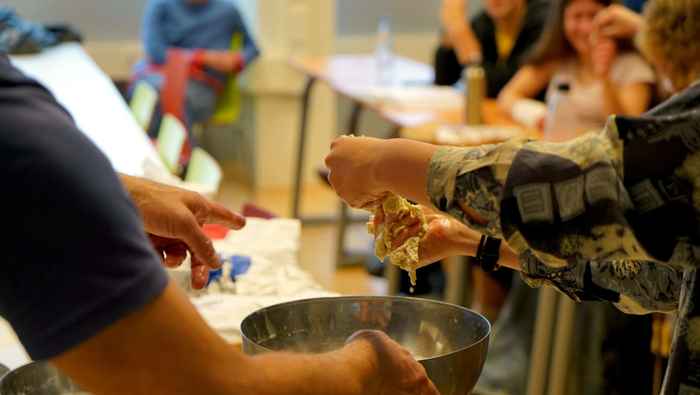
Ilie and Deblais hope to open the Culinary Science course to all UvA students and employees starting the academic year 26/27. “Culinary science provides a great opportunity to teach the exact sciences,” says Ilie, a computational chemist at the Van ’t Hoff Institute for Molecular Sciences (HIMS). “Your whole life revolves around food, and there’s a lot of science behind cooking”, adds Deblais, a physicist at the Institute of Physics (IoP). “Cooking and baking are perfect topics for sparking curiosity about physics and chemistry and teaching science in a fun and accessible way.”
Inspired by successful food-science courses at Harvard, ETH Zürich and elsewhere, the two scientists developed Culinary Science as an honours course at the Faculty of Science, open to all students in the natural sciences and computer science. They invited food professionals to share their practical insights, explaining the science behind all-day kitchen phenomena in tandem with the faculty’s lecturers. A golden move, as it turns out. Ilie: “Students are very curious to understand the science that makes them improve their cooking.” Deblais: “We dive into the science behind cooking, exploring how physics, chemistry and biology shape the textures, aromas and flavours we experience every day”.
From bread elasticity to emulsions, coffee and wine, students discover how fundamental scientific principles translate into culinary creativity. Students for instance learn about gluten networks, Maillard reactions, emulsification, fermentation, rheology of dough, coffee brewing, and aroma chemistry.
Novel ways of teaching
For Ilie and Deblais, Culinary Science shows how UvA educators are developing novel, innovative ways of teaching that stimulate interest and improve knowledge transfer. The enthusiasm comes not only from students, “who hardly ever skip a class”, but also from lecturers who like the out-of-the-box format of the course. Among them are HIMS professors Sander Woutersen and Jan van Maarseveen, who contributed on wine making. At IoP, Prof. Daniel Bonn taught the science behind bread, Prof. Noushine Shahidzadeh contributed on salt, and Prof. Krassimir Velikov (also of Unilever) reflected on emerging challenges in the food industry.
The good reception encourages the two coordinators to refine the course. Next year, Deblais and Ilie hope to welcome even more professional cooks: chocolate makers, sommeliers and other food professionals across a variety of culinary traditions and topics. And by opening enrolment to the all UvA community and beyond, they aim to attract, encourage and inspire as many students and colleagues as possible.
See also
Students make bread during lecture: full classroom in course on science behind cooking