Printing with ice
3 September 2026
Cooling through evaporation
The secret of ice printing lies in so-called evaporative cooling – a principle that mammals, including humans, also use to regulate their body temperature. When you sweat, the water on your skin evaporates and the skin cools down.
The same thing happens when printing with water in a low-pressure vacuum chamber: even at room temperature, the water evaporates very quickly. As each water molecule evaporates, it takes with it a small amount of heat, causing the remaining water to become increasingly colder, eventually cooling to below zero degrees Celsius. At that point the water is still liquid, but supercooled. As soon as the ultra-thin stream (thinner than a human hair: 16 micrometres) hits the already formed layer of ice, it freezes instantly.
Printing a profile
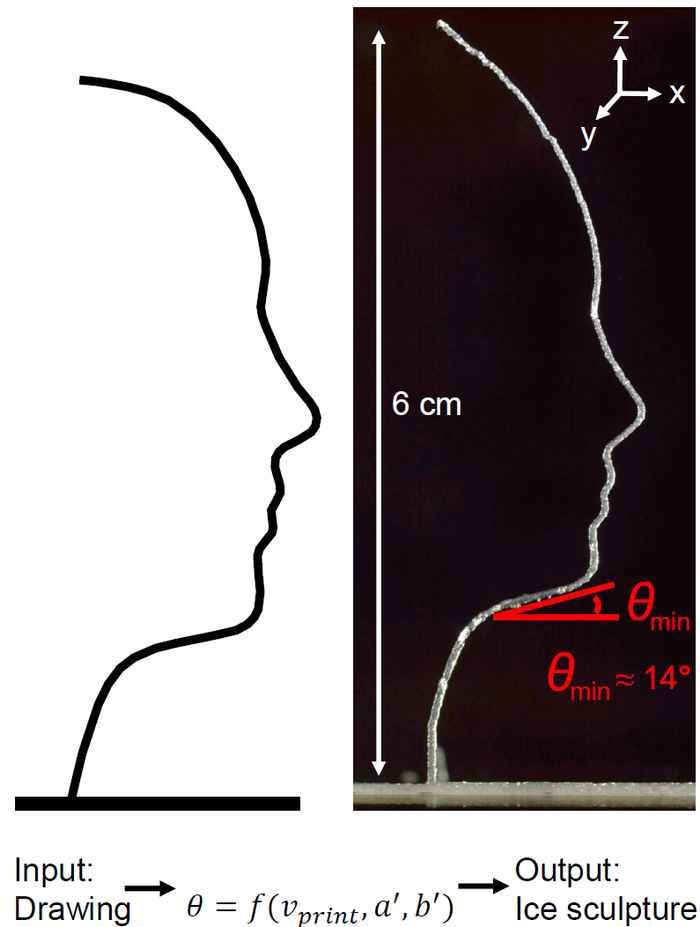
Last December, the work of physicists Menno Demmenie, Stefan Kooij and Daniel Bonn gathered a lot of attention when the researchers 3D-printed a Christmas tree. In the article that was published in the Proceedings of the National Academy of Sciences this week, they show that the method can also be used to print small pillars of ice under an angle, simply by varying the speed of the 3D printer. This makes it possible to print profiles in ice that can have almost any shape and are strong enough that they don’t need to be supported from below – in contrast to how ordinary 3D-printing works. The video below shows how the profile of a human face, making angles as small as 14 degrees with the surface, is printed:
The method is versatile and very clean: when you turn off the vacuum pump, everything melts neatly back into clean water. And the results are not just aesthetically nice and a demonstration of physics in action; there are practical applications as well. The technique opens doors for biology, where pure ice structures can be used as scaffolding for tissue, and for microfluidics where it can form intricate channels by melting away the ice. Looking ahead further, the technique could even be used on Mars, where it is cold and the atmosphere is thin – perfect conditions for using the same technique to build structures with local water.
Publication
Three-Dimensional Printing of Ice Structures via Evaporative Cooling in Vacuum, M. Demmenie, S. Kooij and D. Bonn. Proceedings of the National Academy of Sciences 123 (36) e2608173123 (2026).