Theoretical physicists get a grip on the electron electric dipole moment
21 May 2026
In a new article in the prominent journal Physical Review Letters, a group of researchers including UvA-IoP/Nikhef researchers Jordy de Vries and Lemonia Gialidi and RUG/Nikhef researcher Heleen Mulder perform a theoretical study of electric dipole moments in paramagnetic molecules. Various experiments worldwide are searching for EDMs, as they could shed light on subtle differences between matter and antimatter.
In principle, antimatter is the mirror image of matter, with opposite electric charge. However, already within the Standard Model the so‑called CP symmetry between matter and antimatter is not entirely perfect. Breaking of CP symmetry is also a required ingredient to explain one of the big puzzles in fundamental physics, namely why the universe contains mostly matter and hardly any antimatter.
The Standard Model does not contain enough symmetry breaking to justify this imbalance, so physicists have been hunting for CP symmetry breaking beyond the Standard Model. EDM experiments are very precise tools in this hunt.
So far, however, the experiments have not yielded a nonzero value for any EDM. It is already established that any EDM must be very small, but it is not known whether it is exactly zero. To date, the measurements have consistently set upper limits on such a tiny fundamental asymmetry.
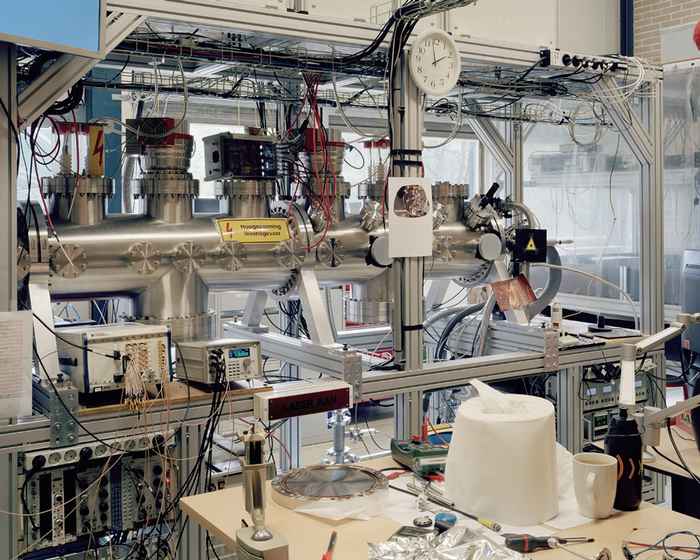
Among others, the Nikhef group at the University of Groningen is building a measurement setup to search for the electric dipole moment of the electron. The experiment uses measurements on barium fluoride (BaF) molecules.
Electrons in these molecules are subjected to extremely strong internal electric fields, which could reveal subtle asymmetries. De Vries and PhD candidate Mulder are directly involved in the eEDM experiment as theorists.
So far, such molecular EDM experiments are mainly interpreted in terms of the electron electric dipole moment. However, these experiments are also sensitive—although less so—to possible CP violation inside the atomic nuclei in the molecules. While dedicated neutron and atomic experiments that target this nuclear CP violation are still more sensitive, future molecular experiments, like the one in Groningen, could close much of this gap.
De Vries and his team are building a theoretical bridge between the molecular measurements and possible nuclear CP violation. The key development of the PRL study is to demonstrate how molecular measurements can constrain the electric dipole moments of protons and neutrons inside nuclei.
The PRL study also examines what contributions different types of physics beyond the Standard Model would make to a potentially measured EDM in such systems. This can provide guidance to theorists in the event of a concrete measurement.
PhD candidate Lemonia Gialidi, corresponding author of the study in Physical Review Letters, often compares the approach to detective work. “If a measured EDM is the crime, we try to pinpoint the potential culprits,” she says.