Testing dark matter models with current observations
29 May 2026
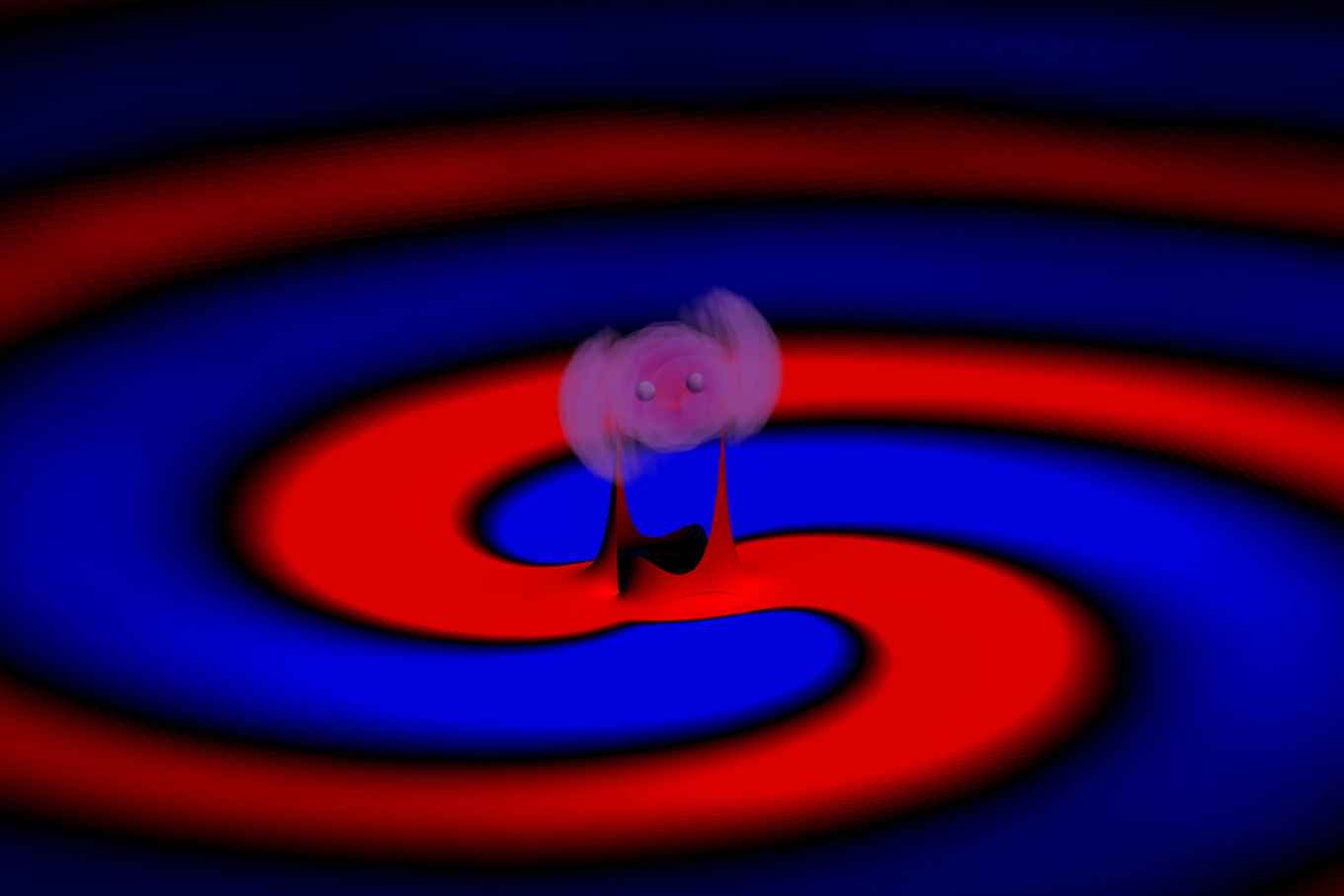
Dark matter is believed to account for most of the matter in the universe, yet it appears to interact with ordinary matter only through gravity. Near black holes, gravitational interactions could trigger the growth of dense dark matter structures. If these structures persist during the inspiral of two merging black holes, they can alter the binary dynamics and leave imprints on the gravitational-wave signal.
A new model developed by UvA-IoP and GRAPPA researcher Rodrigo Vicente, in collaboration with Soumen Roy (UC Louvain), Josu Aurrekoetxea (MIT), Katy Clough (Queen Mary University of London), and Pedro Ferreira (University of Oxford), predicts how gravitational waves would look if they were produced by black holes moving through a dense cloud of dark matter rather than through empty space.
Previous studies had already shown that gravitational waves could help us understand how ordinary and dark matter behave in the extreme gravitational fields around black holes. However, most of this work has focused on future observations with space-based detectors such as LISA. Because these experiments will observe longer signals and different types of sources, they are expected to provide unparalleled sensitivity to such effects.
In contrast, the recent work instead explored what can already be learned about specific dark matter models using gravitational-wave data available today. The researchers used their model to test whether any signals detected on Earth match the predicted patterns of dark matter imprints. To do so, they applied the model to publicly available data recorded by the LIGO-Virgo-KAGRA gravitational wave observatories (LVK) during their first three observing runs. Although LVK detected many gravitational-wave signals during this period, the team focused on the clearest cases: 28 events produced by binary black hole mergers.
For each event, the researchers compared the observed gravitational-wave signal with their prediction for how the same event would look if it occurred in a dark matter environment. They also compared it with the standard expectation: a signal produced by black holes merging in vacuum.
Of the 28 signals analysed, 27 were consistent with the standard vacuum scenario. One event, GW190728, stood out because the dark matter model described the data better than the standard model of black holes merging in empty space. This, however, does not yet amount to evidence for dark matter. The statistical significance is too low, and further independent checks will be needed.
Overall, the work shows that some of the more extreme dark matter models can already begin to be tested with signals observed by current gravitational-wave experiments.
Publication
Scalar Fields around Black Hole Binaries in LIGO-Virgo-KAGRA. Soumen Roy, Rodrigo Vicente, Josu C. Aurrekoetxea, Katy Clough, and Pedro G. Ferreira. Phys. Rev. Lett. 136 (2026) 191402.