Materials that learn to change shape
7 April 2026
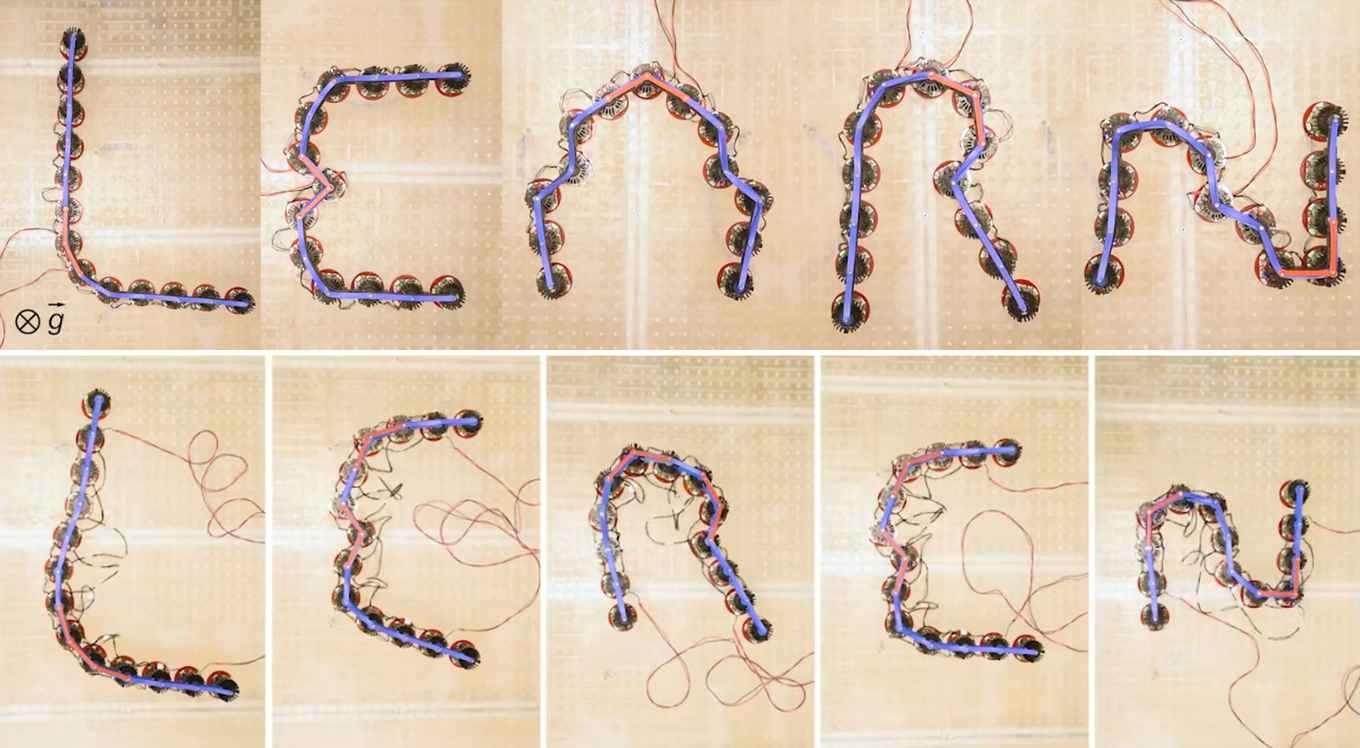
Normal materials have fixed, predetermined responses when a force is applied to them, whereas robots have pre-programmed behaviours. In stark contrast, living materials such as cells and brainless organisms can adapt extremely well to changing conditions. Inspired by nature, the research team created synthetic materials – metamaterials – that learn and adapt without a central “brain”.
The worm-like metamaterials progressively learn how to change shape by being trained on examples. They can forget old shapes and learn new ones, or learn and remember multiple shapes at once and toggle between these shapes. This allows them to perform advanced tasks such as grabbing an object or moving around (locomotion).
“The most exciting observation of our research was that learning gives our metamaterials the ability to evolve – once the system starts to learn, the possibilities of where it ends up feel almost limitless,” says Yao Du, PhD candidate in the Machine Materials Lab at the UvA and first author of the paper.
The metamaterials are chains of identical motorised hinges linked together by an elastic skeleton. Each hinge has a microcontroller that measures how far it is rotated, remembers its past movements and exchanges information with the hinge’s neighbours. In response to this information, each hinge can exert a torque (a force of rotation), which changes the stiffness and preferred position of each hinge, so that the material learns to adopt a new shape.[1]
Moving forward with materials that learn
The current research builds on previous research from the Machine Materials Lab in ‘brainless’ locomotion, where ‘odd’ objects designed by the team were shown to autonomously roll, crawl and wiggle over unpredictable terrain. However, these metamaterials could not learn or memorise new behaviour.
Du adds: “In future work, we aim to achieve learning time-dependent behaviour instead of changes into a static shape. For example, enabling metamaterials to learn different locomotion gaits, such as crawling or rolling, depending on environmental stimuli. We also plan to investigate so-called stochastic scenarios, where learning happens with noise and uncertainty. In such cases, the system would adapt probabilistically rather than deterministically, improving robustness and flexibility in complex environments.”
Interest in robots and materials that can learn and adapt has grown dramatically over the last few years. The 2026 Dutch Research Agenda (NWA) includes a call for research under the theme ‘Materials that learn and learning how we responsibly use them’. The NWA programme ‘Research along Routes by Consortia’ aims to enable inter- and transdisciplinary innovative research that brings scientific and societal breakthroughs within reach.
In August, a new PhD candidate will join the UvA’s Machine Materials Lab in a joint project with the Learning Machines group at AMOLF. Building on Du’s research, her research will focus on realising new materials capable of learning.
Publication
Yao Du, Ryan van Mastrigt, Jonas Veenstra and Corentin Coulais. Metamaterials that learn to change shape. Nature Physics (2026)
—
[1] To teach the metamaterial a new shape, the researchers first bend one or more hinges in the chain away from their preferred shape, and fix these ‘input’ hinge positions in place. To train the material to respond to this input by adopting a new shape, the researchers then repeatedly nudge the remaining hinges to the desired new shape, clamping the nudged hinges in place before releasing them again. In each step, which the researchers call an ‘epoch’, the microcontrollers in the metamaterial learn to apply new torques on their respective hinges, changing the hinge stiffness and interactions along the chain until the chain naturally adopts the ‘clamped’ shape. After this, any time the chain senses the input, it will change its shape to the clamped position.