Materials – but not as we know them
14 April 2026
Active matter in the lab
When we think of materials, we usually think of substances like metal, concrete, glass or rubber. What these examples have in common is that they are inactive: when pushed, pulled, shifted or sheared they may move or deform, but only by using the energy that is provided from the outside through the forces applied to them.
There exists another very interesting class of materials: that of active matter. Active matter has energy of its own and can use this energy to respond to external forces – sometimes in rather unexpected ways. Active matter is usually found in the world of biology: think of a flock of birds behaving as one single entity that responds to external inputs like wind, terrain changes or the presence of food or a natural resting place.
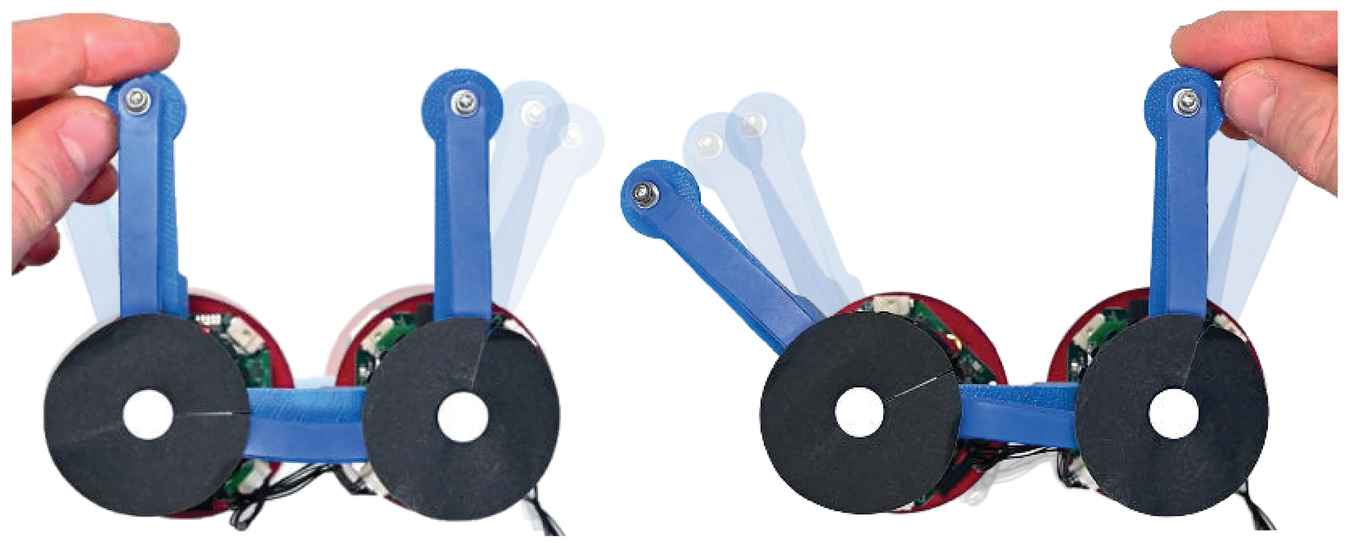
Examples do not just come from the world of biology, though: active matter can also be constructed in the lab. Over the past few years, an international team of physicists at the universities of Amsterdam (The Netherlands), Cambridge (UK) and New South Wales (Sydney, Australia) have become experts at using simple ingredients like small motors, rods and rubber bands to construct active materials that have many surprising – and importantly: useful – properties. At the UvA Institute of Physics, Yao Du, Jack Binysh and Corentin Coulais are involved, as is former PhD student Jonas Veenstra. Two papers by the team have recently been accepted for publication.
Buckling and snapping
Take a paper ticket and compress it between two of your fingers. It will spontaneously lose its stability and buckle one way or the other. Now try to push the buckled state inwards with your other hand. It will resist at first, but then suddenly snap to the other side. The paper ticket is an inactive form of matter: when the external pressure forces it, it will only perform the buckling and snapping once.
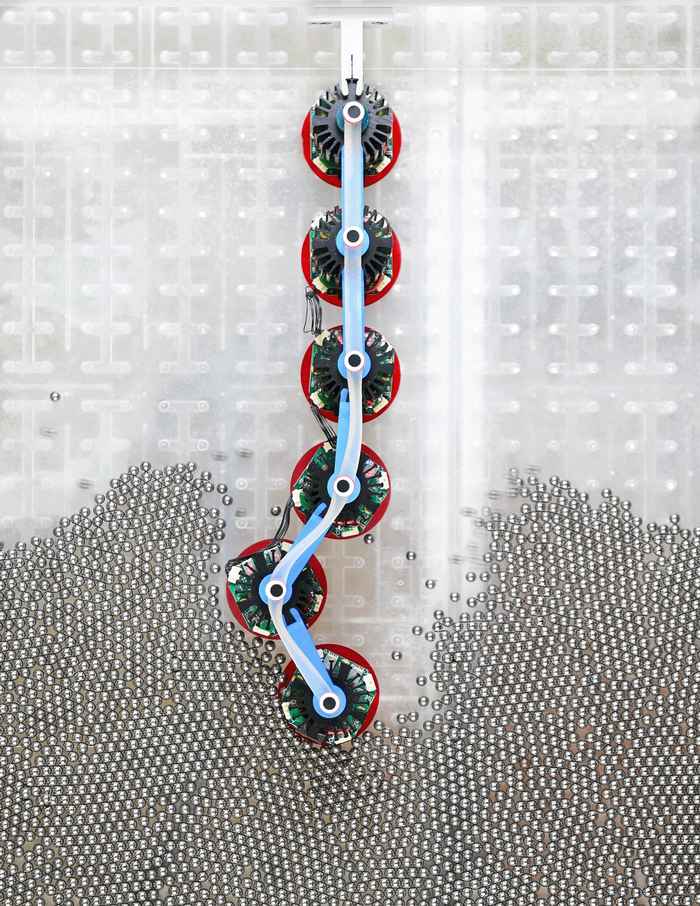
As the researchers have now shown, buckling and snapping drastically change when materials become active. To construct an active material that can undergo buckling and snapping, the physicists connected a sequence of rods to form a chain, with small motors attached to the end points wherever two of these rods meet. The job of the motors was to make the interactions within the chain non-reciprocal: when rod A moves, rod B responds differently (by rotating over a different angle, for example) than rod A responds when rod B moves.
The surprising result was that the chains constructed in this way still showed buckling and snapping when external forces were applied, but this time not just a single buckle and snap: the process could repeat, and oscillations could occur. In technical terms, what happened was that the so-called critical point where the system snapped now became a critical exceptional point. In layman’s terms, this meant that the chains now could start to crawl, walk and even dig.
The paper about the results, with joint first authors Sami Al-Izzi from the University of New South Wales and Yao Du from the University of Amsterdam, was recently published in the Proceedings of the National Academy of Sciences, with an image of one of the buckling chains being used as the cover art for the journal. The work demonstrates a new route to realizing materials that can act autonomously and have several functions – in particular, for use in flexible, “soft” robots. The active materials may form the basis for smarter robot bodies that operate independently of centralized control.
Sometimes, more is less
From building a bridge to assembling nanomechanical devices, when constructing something, engineers rely on many mechanical principles. One of these is known as Le Chatelier’s Principle, and it roughly states that what happens on a small scale, also happens on a large scale. For example, stiffening the components of a structure will stiffen the structure as a whole.
In recent work, the team of physicists have shown that when it comes to active matter, Le Chatelier’s principle does not always hold. In particular, when the building blocks of an active material become more active, the structure as a whole may actually become less active. The authors have shown this by connecting similar motors and rods, this time not in a chain but in a two-dimensional lattice-like structure. In their experiments they measured how the elasticity of this structure as a whole depended on the properties of the individual building blocks.
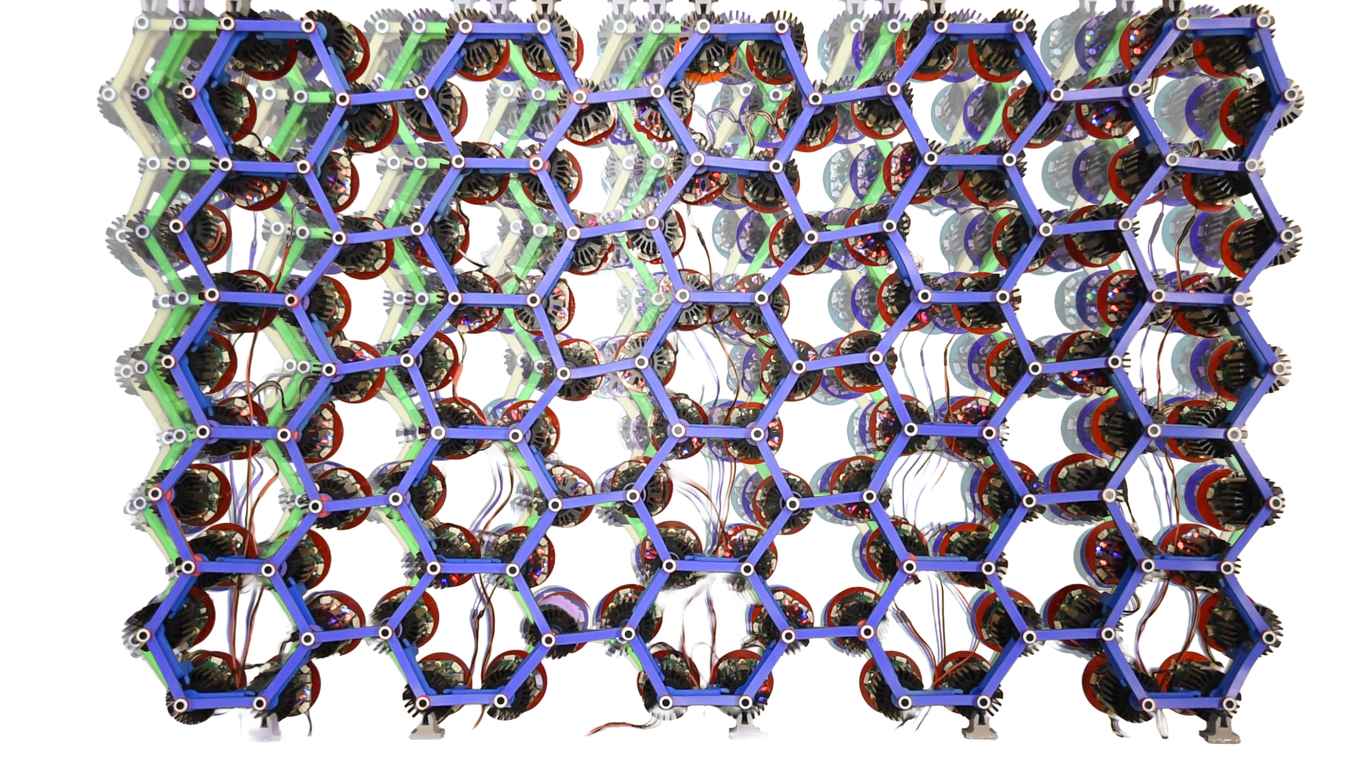
The crucial factor that determines the large-scale behaviour turned out to be the percolation of the active microscopic components throughout the material. Compare this to the percolation of water through coffee: when we make coffee, the powder should not be too dense, or the water will not get all the way through. Similarly, when there is a high density of less active components in a material, elastic responses will not always get through, even if all other components are extremely active.
A paper about this research, with first author Jack Binysh from the research group of Corentin Coulais at the University of Amsterdam, was recently accepted for publication in the journal Physical Review X. Binysh and his colleagues anticipate the discovered breaking of Le Chatelier’s Principle to be fundamentally important to researchers working with active microstructures such as biophysical gels, epithelial monolayers, and neuromorphic networks. Their work will be of broad interest across physics, soft matter science, mechanical engineering, life sciences, and robotics.
Publications
Non-reciprocal buckling makes active filaments polyfunctional, Sami C. Al-Izzi, Yao Du, Jonas Veenstra, Richard G. Morris, Anton Souslov, Andreas Carlson, Corentin Coulais, and Jack Binysh. Proc. Natl. Acad. Sci. U.S.A. (2026) 123 (11) e2531723123.
More is less in unpercolated active solids, Jack Binysh, Guido Baardink, Jonas Veenstra, Corentin Coulais, and Anton Souslov. Phys. Rev. X 16 (2026), 021012.