A relaxing bath for hard-to-study ions
Researchers at the University of Amsterdam have demonstrated a new way to perform precision spectroscopy on ions (electrically charged atoms) that are difficult to cool with lasers. By immersing a single ytterbium ion in an ultracold bath of lithium atoms, they achieved measurements six to nine times more precise than those obtained with a conventional discharge-cell setup.
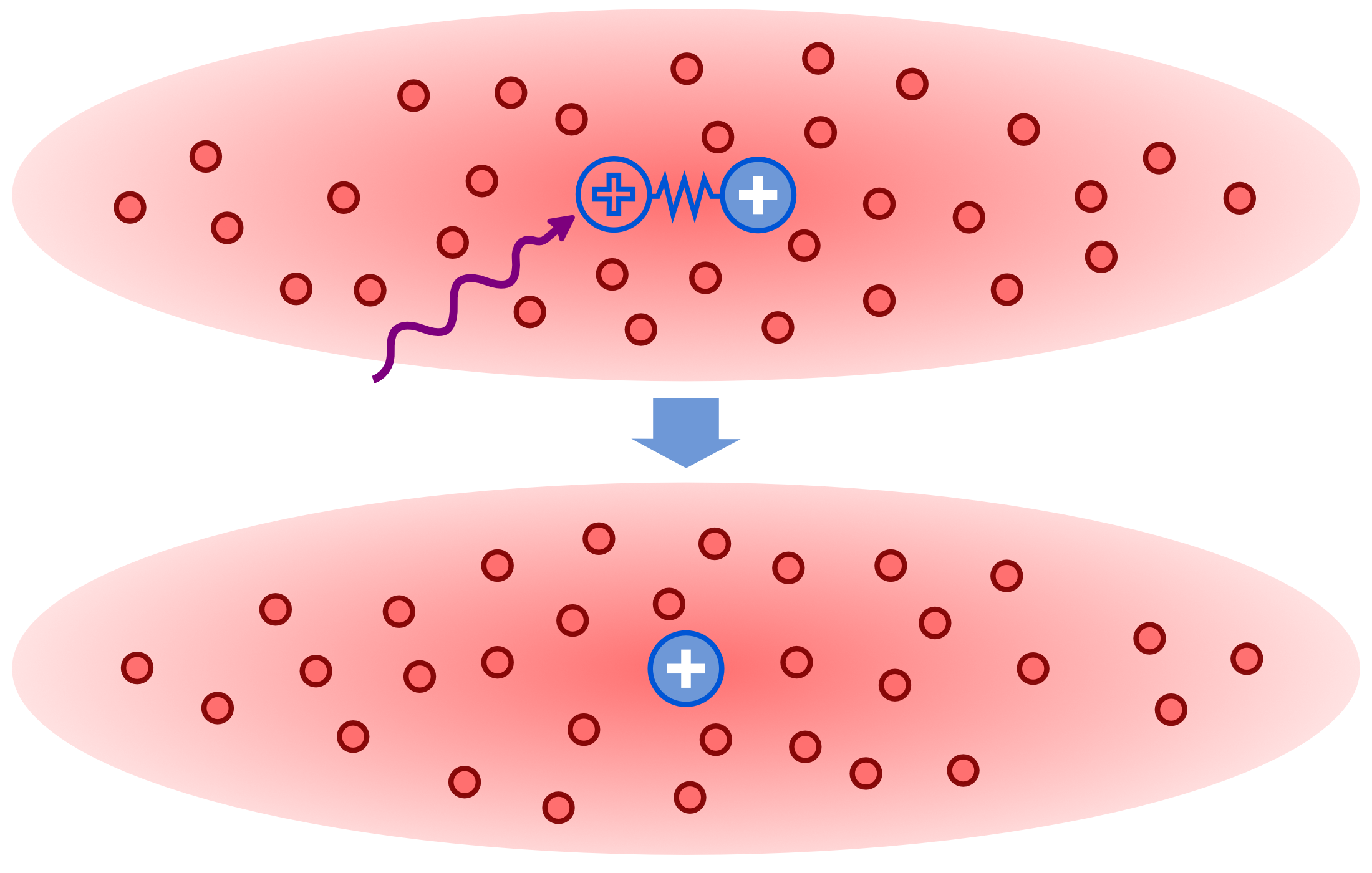
Electrons in an ion can occupy many distinct, finely spaced energy levels. These levels can be investigated with laser spectroscopy, which involves testing how individual ions respond to laser light of specific wavelengths. Such measurements can help scientists to improve their models for atomic structure, to build ultrastable atomic clocks and even to search for new physics.
But for such precision measurements, the ion needs to be brought to a near standstill. This requires working at extremely low temperatures, trapping the ions in an electric field, and minimising collisions with other particles.
Since the 1980s, laser cooling has been a standard way to slow down trapped ions. An ion absorbs laser light and then emits light in a random direction, gradually reducing its motion along the laser beam.
However, this technique works for only a handful of ion types. In more complex ions, an electron can become trapped in a long-lived ‘metastable’ energy level. Additional lasers are then needed to return the electron to the lowest available energy level, making the experiment increasingly complicated.
Instead of relying on a large and complex set of lasers, a cold buffer gas can be used. Much like an object losing heat in a cold bath, the trapped ion loses energy and can return to its lowest-energy ‘ground state’ through repeated collisions with the bath atoms. Unfortunately, common buffer gases such as cryogenic helium are simply not cold enough for cooling many complex ions to their ground state.
Instead, Amsterdam physicists Egor Kovlakov and Rene Gerritsma used a laser-cooled buffer gas of lithium atoms. Thanks to the laser cooling, the buffer gas reached temperatures as low as a few microkelvin, millionths of a degree above absolute zero. This is far below what can be achieved in cryogenic systems. They then immersed a single ytterbium-173 ion (173Yb+) in this ultracold bath and used it to demonstrate their new spectroscopy technique.
The researchers immersed a single ytterbium-173 ion in the ultracold lithium gas and illuminated it with pulses of laser light. The ion absorbed light only at wavelengths related to the differences between its electron energy levels.
After absorbing light, the ytterbium ion could capture an electron from a lithium atom and escape from the trap. The researchers detected its disappearance through the change in motion of a neighbouring ytterbium-174 ion. By recording the wavelengths at which this happened and repeating the experiment many times, they could reconstruct part of the energy-level structure of ytterbium-173.
“The experiment is a proof of principle. Ytterbium-173 can already be investigated using conventional laser cooling, but the new technique could ultimately make precision measurements possible for much more complex ions,” says Gerritsma.
The researchers already see several ways to improve the technique further. Gerritsma: “The most obvious improvement lies in the choice of buffer gas. While lithium is easy to bring to ultracold temperatures, it is also highly reactive.”
Lithium’s reactivity makes the present detection method possible, but it also means that the measured ion is lost. A less reactive buffer gas could allow researchers to repeat measurements on the same ion, further improving precision.
Searching for the ideal ultracold gas
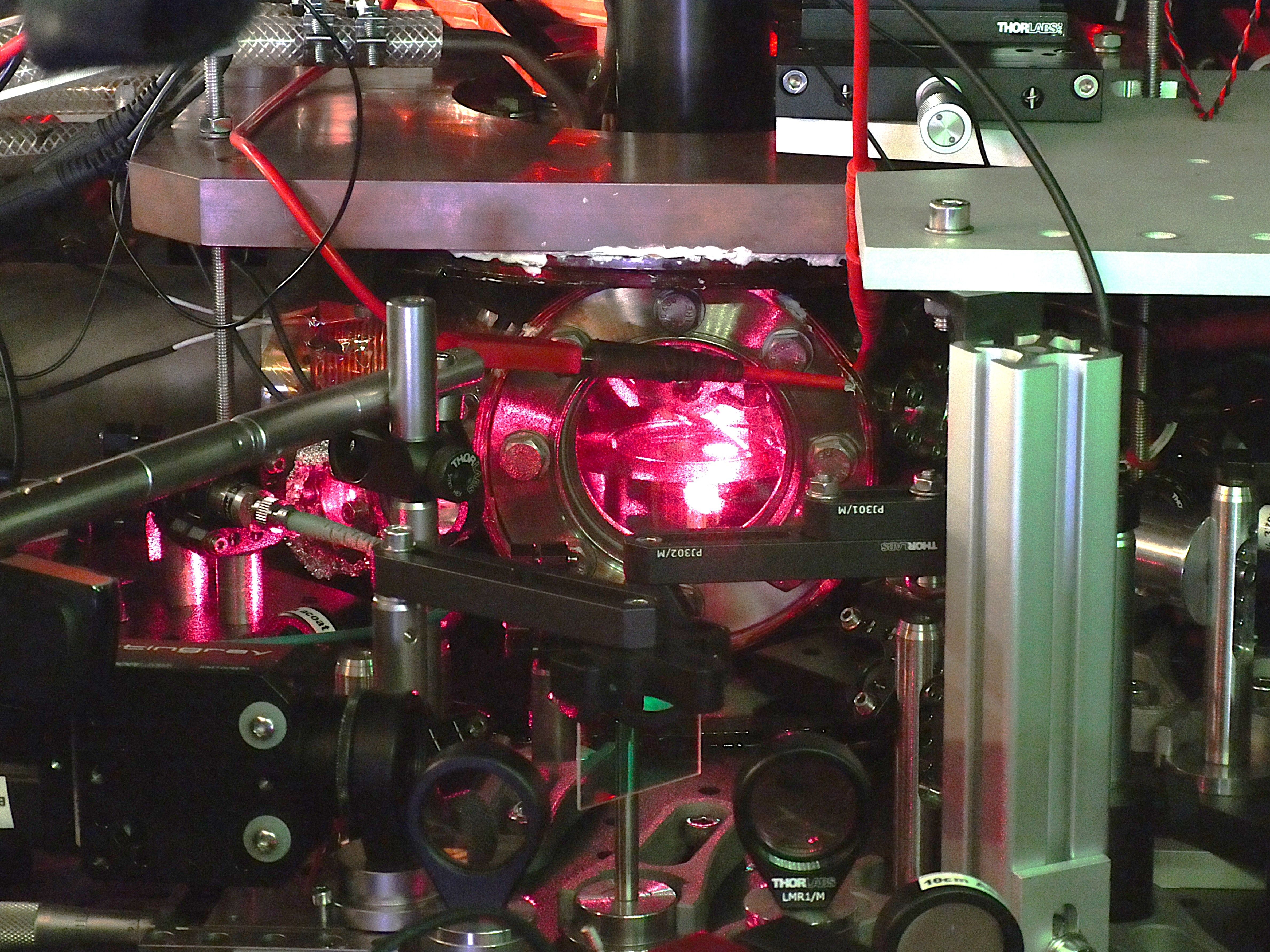
An ideal buffer gas must be light, chemically stable, easy to cool and able to help reset the ion’s electronic state. Finding the right atom is difficult, but the researchers identify chromium as a particularly promising candidate.
“Unfortunately, none of the light atoms look particularly appealing for the job,” notes Gerritsma. “Hydrogen requires extreme UV lasers, while helium can only reach microkelvin temperatures in its metastable state. Such a metastable buffer gas would react violently with any spectroscopy ion it would meet. In fact, scanning through the periodic table, the lightest atom that fulfils all the demands is chromium.”
The method could eventually be applied to complex ions such as singly ionised gadolinium and dysprosium. These elements have many isotopes, making them promising candidates for King plot analysis, in which researchers compare subtle shifts in spectral lines between isotopes. Unexpected deviations from the predicted pattern could provide evidence of a previously unknown interaction between neutrons and electrons.
The method could also work for precision spectroscopy on certain molecular ions, if chemical reaction rates are low enough.
Publication
Precision spectroscopy of a trapped ion using a bath of ultracold atoms, E. Kovlakov and R. Gerritsma. Physical Review Letters 137 (2026) 223201.