Lorenz Eberhardt receives 2026 Philippe Meyer prize
UvA-IoP physicist Lorenz Eberhardt will receive the 2026 Philippe Meyer prize, a prize established by the Ecole Normale Supérieure in Paris to reward exceptional contributions to the field of physics by a young researcher.
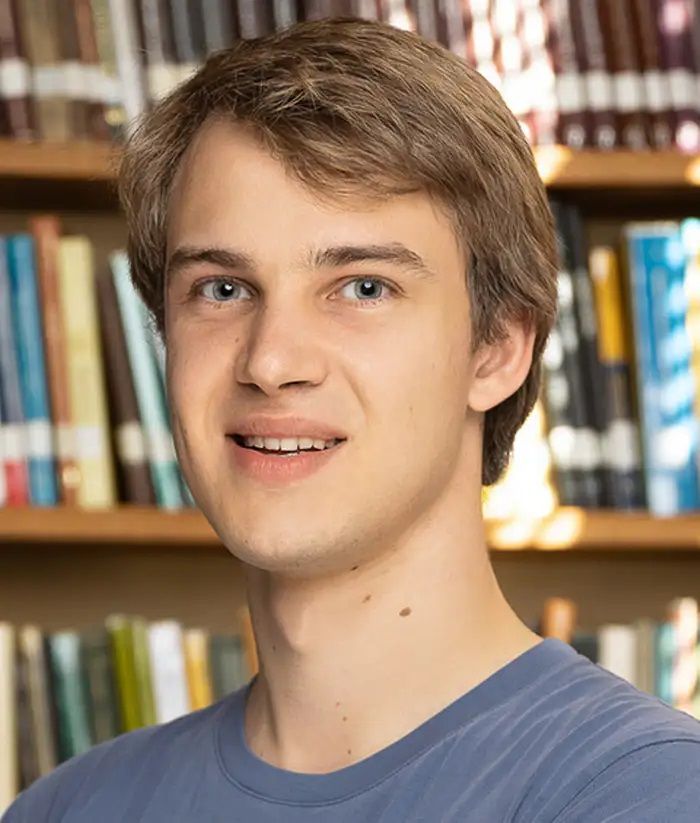
The Philippe Meyer prize consists of a financial award of ten thousand euros, in addition to an invitation to spend one month as a visitor at the Philippe Meyer Institute at ENS in Paris. A specific scientific field is chosen for every call; for the 2026 edition this field was “Quantum Field Theory, Strings and Gravity”. Nominations for the prize were open to all members of the international scientific community, and out of the nominated candidates the selection was made by an international jury.
Novel methods for quantum gravity
Lorenz Eberhardt is currently an associate professor at the University of Amsterdam. He obtained his PhD at ETH Zurich, after which he spent four years as a long-term postdoctoral member at the famous Institute for Advanced Study in Princeton. In 2023, Eberhardt joined the UvA Institute of Physics as part of an effort to attract young, talented researchers. He works on several topics in theoretical physics, specializing in string theory and quantum gravity. For his work, Eberhardt has previously received the Gribov Medal of the European Physical Society and the Early Career Best Paper Prize of the Journal of Physics A.
The jury report states that Eberhardt receives the prize “for developing novel and powerful methods for the perturbative quantization of gravity in two and three dimensions”.
Albert Einstein taught us that gravity should be viewed as a phenomenon in four dimensions: the usual three spatial directions plus time. Ever since Einstein’s work, physicists have attempted to unite his ideas with those of quantum theory. Quantum gravity in fewer than four dimensions is a promising theoretical laboratory for this in which some of the complications of the real world, such as gravitational waves, are absent. As a result, it is sometimes possible to solve the mathematical equations underlying such a theory exactly, without needing any approximations. This allows Eberhardt and his colleagues to fully elucidate the properties of the theory. One example of such a scenario is the so-called holographic duality that relates theories of quantum gravity with ordinary – and therefore: much better understood – quantum mechanical systems.
Eberhardt will receive the prize during an award ceremony at the Philippe Meyer Institute which will take place early in 2027.