STW grant for 'CSI Amsterdam'
Researchers of the Institute of Physics at the UvA received an STW grant for a project to use blood stain patterns to allow for a better reconstruction of a crime. The project will be carried out together with colleagues from the NFI.
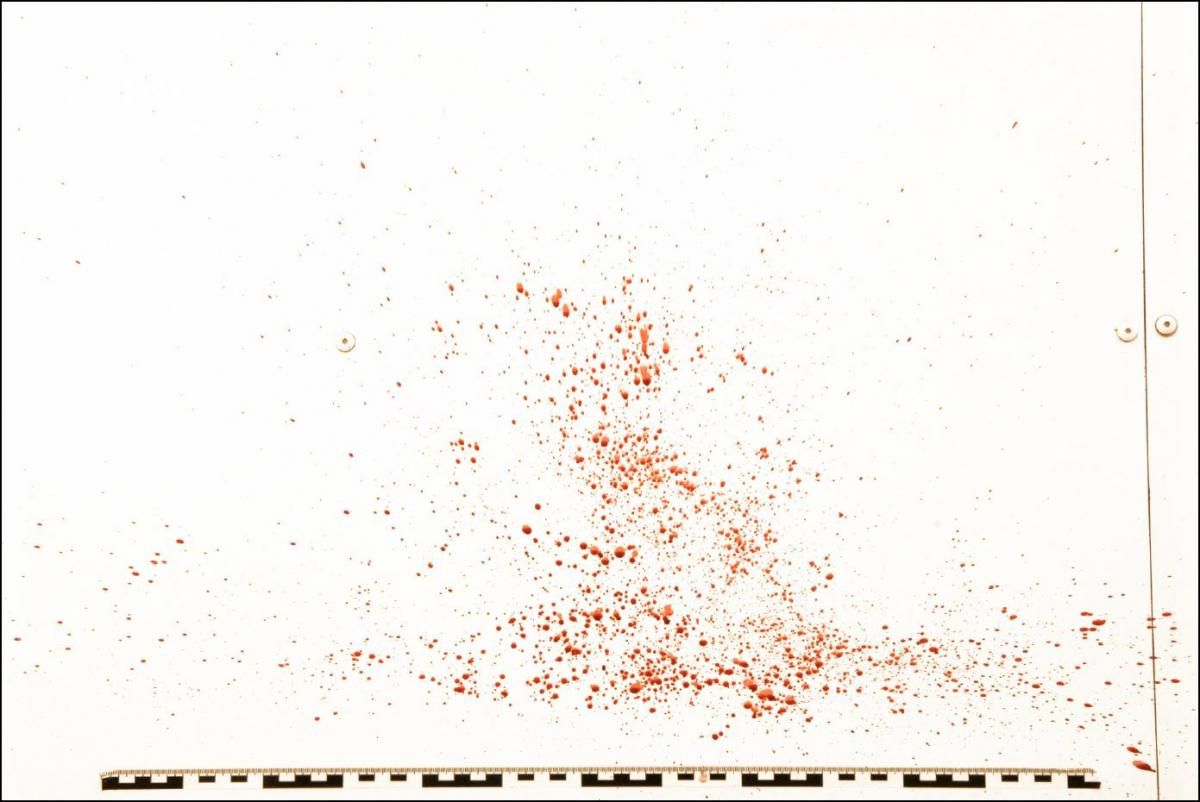
Blood stains at a crime scene provide information about the location and pose of both the culprit and the victim at the time of the crime. Current software programs aimed at extracting information from blood stains assume the blood droplets to fly in straight lines. In reality, this is the case: gravity and air friction influence the trajectory of the droplets. In the granted STW project, a research team led by prof. Daniel Bonn (Institute of Physics, UvA) will develop a physical model in which gravity and friction are correctly taken into account, and translate this into a software package. This will greatly improve the accuracy of blood stain analysis.
CSI Amsterdam
To arrive at a proper physical model, the researchers will first experimentally study how blood flows on a variety of surfaces, what volume of blood actually causes a certain stain, how the three dimensional trajectory of the droplet was, under which angle and with velocity the droplet impacted, and finally how this depends on the porosity of the surface. CSI Amsterdam obviously comes one step closer with this project.
Apart from the Netherlands Forensic Institute (NFI) also two companies (Sense-IT and e-Semble, both acting in the field of scanner and visualization technology) and the Dutch police participate in the research project, which is entitled 'Accurate Bloodstain Pattern Analysis at the Crime Scene'. The budget granted by STW amounts to k€420, to be spent on two PhD students and an material budget.
Other granted projects
In this round, the board of STW has granted five new technological and scientific projects for a total amount of 2,65 million euros. The users in these projects contribute for in total almost 650,000 euro to the research, often in kind with manpower or facilities.