UvA physicists report direct measurement of the free energy of colloidal glasses
A team of physicists of the University of Amsterdam have for the first time performed a direct measurement of the free energy of a glass, in their case a hard sphere glass. They published their results as an Editor’s Suggestion Letter in the prestigious journal Physical Review Letters.
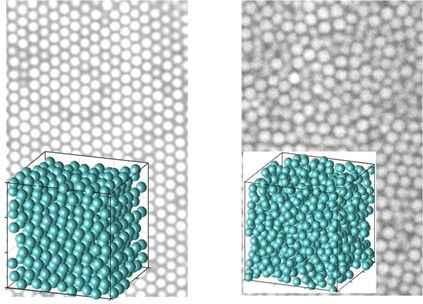
Although glasses have been known to mankind for roughly 5000 years, the question why glass has a liquid-like structure but solid-like mechanical properties is still intensely debated. The usual interpretation is that glasses are liquid-like, but the energy necessary to make a glass flow like a liquid is so large that for all practical purposes it simply does not flow, but rather behaves as a solid. The research team, consisting of Rojman Zargar, Bernard Nienhuis, Peter Schall, and Daniel Bonn from the Institute of Physics, proposes the first direct experimental measurement of the free energy of a glassy system that confirms this picture. The physicists connect the dynamics in this system with the famous Gutenberg-Richter law in seismology: in the same way that it is highly unlikely to have very large earthquakes, it is also highly unlikely to see motion of a large number of atoms, molecules or particles in a glass: it consequently does not flow.
Glass transition
One of the most important unsolved problems in condensed matter physics is the nature of the so-called glass transition. The free energy is central to the understanding of the behavior of glassy systems: the commonly accepted idea is that the energy necessary to displace even a single atom, molecule or particle in the glass is so large that this never happens in practice. Yet, in general it is unfortunately impossible to measure the free energy experimentally.
The UvA researchers report the first ever experimental measurement of the free energy of a glass, which they achieve by studying a so called hard-sphere colloidal glass. These are glasses made of spherical particles that are so large that the structure and dynamics of the glass can be studied with a powerful microscope. Because the particles do not interact with each other, the researchers show that the free energy of the sphere system is dictated only by entropic contributions, meaning that the free energy is entirely dicted by, and can be determined from, the structure of the system. Therefore, the determination of the free energy is possible by the experimental measurement of the positions of all the particles in the glass. The results yield several new insights in the glass transition, such as the assertion that ‘aging’, the time evolution of the glass is indeed driven by a slow decrease of the free energy of a glassy system. But perhaps the most remarkable finding is the power-law dependence of the probability of particle rearrangements on the free energy change associated with the rearrangements. Their findings are completely analogous to the Gutenberg-Richter law in seismology, which predicts that small earthquakes are much, much more likely to occur than large earthquakes, also in terms of the energy released by the quake. This addresses the central question about glassy dynamics, namely, how the structure impedes flowing of the glass.
Publication details
Rojman Zargar, Bernard Nienhuis, Peter Schall, Daniel Bonn, Direct Measurement of the Free Energy of Aging Hard-Sphere Colloidal Glasses, Physical Review Letters 110, 258301 (2013).