Physicists solve mysteries of quantum magnets
A team of scientists, including prof. Jean-Sébastien Caux of the UvA’s Institute of Physics, has made a breakthrough into the properties of quantum magnets that can impact our understanding of fundamental physics. They published their results in the prestigious journal Nature Physics.
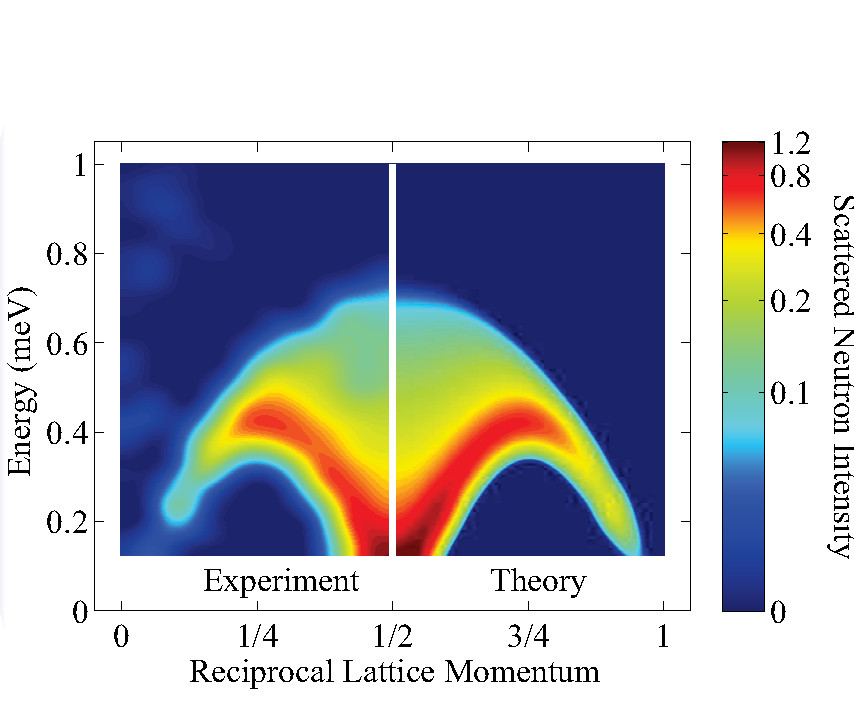
Antiferromagnets are materials that display interesting magnetic properties when cooled down close to absolute zero temperature. Different to conventional magnets, which can be described with classical physics even at the atomic level, antiferromagnets such as copper sulfate are quantum systems where electrons behave in a complex cooperative manner. Their study belongs to the field of quantum many-body physics, a branch of science that studies the collective behavior of vast assemblies of interacting particles. Thus far, only very few exact solutions to quantum many-body problems are known and even fewer have been realized experimentally. In a recent publication in Nature Physics, theoretical calculations performed at the University of Amsterdam were matched to measurements performed by scientists from EPFL’s Laboratory for Quantum Magnetism (LQM), in which the collective quantum-mechanical magnetism in crystals of copper sulfate is shown to relate to properties of quasiparticles known as spinons.
Copper sulfate pentahydrate is a commonly found material that is often used to keep swimming pools clear of algae. Because it easily grows as large crystals, it is also very popular in schools’ chemistry classes where many students across the world have been inspired by their beautiful and intense blue color. But copper sulfate has some other fascinating properties that most of us might not realize.
Quantum Spin Liquids
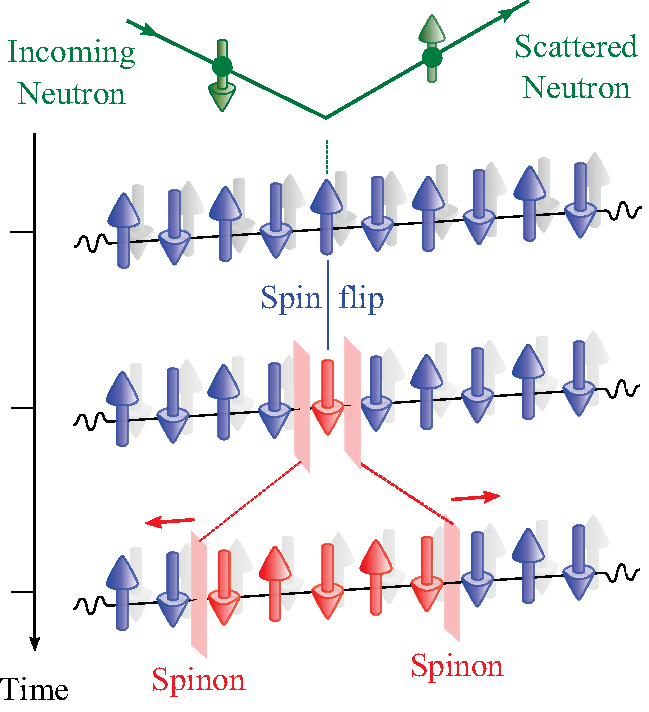
When cooled down close to absolute zero temperature, this material hosts a fascinating state of matter called a “quantum spin liquid”. Magnetism essentially originates from a material’s electrons spins, sometimes referred to as magnetic moments. When conventional magnets (such as ferromagnets) are cooled down to low temperatures, their electrons’ spins align together in a simple static pattern. In contrast, in a quantum spin liquid state like discovered in copper sulfate, the electrons’ spins adopt an alternating up-down pattern which is `melted' by quantum fluctuations. This causes the spins to constantly change direction, similar to the molecules floating in a liquid. Despite this constant change in direction, spins remain correlated over long distances and `entangled' with one another. Such quantum entanglement is the key property which scientists hope will lead to future quantum computers.
Theoretical predictions for the properties of such spin liquids were obtained by Jean-Sébastien Caux of the UvA's Institute of Physics (IoP), via an exact solution of the well-known Heisenberg model. These predictions were then matched to inelastic neutron scattering measurements on a copper sulfate crystal cooled down to a temperature close to absolute zero to turn it into a quantum spin liquid. This matching between theory and experiment reveals that the magnetic properties of copper sulfate can no longer be described by the individual behavior of the magnetic moments carried by each individual electron in the sample. Instead, flipping the magnetic moment of one single electron creates pairs of spatially separated quantum objects called spinons. The accuracy of the experiments made it possible to detect not only spinon pairs but even the theoretically predicted splitting (also called fractionalization) into four-spinon states. By carefully accounting for the intensity of the experimental signal, the team thereby proved and quantified the actual existence of states composed of more than two spinons. Their paradigm-shifting discovery is not only expected to affect future physics textbooks, but, more importantly, allows researchers to develop a simple picture for understanding multi-particle excitations in quantum systems.
Publication details
Martin Mourigal, Mechthild Enderle, Axel Klöpperpieper, Jean-Sébastien Caux, Anne Stunault and Henrik M. Rønnow, Counting fractional spinon excitations in the quantum Heisenberg antiferromagnetic chain, Nature Physics, Advance Online Publication (2013).