Efficient light emission from silicon quantum dots with carbon coating
Quantum dots made of silicon appear the ideal material for use in future flexible opto-electronic or photovoltaic applications. Silicon is non-toxic, biocompatible and highly abundant. Also in the form of quantum dots (QDs) silicon is highly efficient in absorbing and emitting light. Researchers of the University of Amsterdam, in collaboration with colleagues from Wageningen University and Twente University, have now for the first time found a way to enhance the optical properties of silicon QDs. Their results make them optically equivalently useful as the QD variants based on the highly toxic elements cadmium and selenium. They published their results in the latest issue of the Nature journal 'Light: Science & Applications'.

Quantum dots in various applications
Materials with efficient light emission and/or absorption have numerous applications, such as in phosphors, LEDs, lasers, displays, sensors, photo-detectors, solar cells, and imaging in medicine. Quantum dots (QDs) of semiconductor materials with a direct bandgap offer not only efficient emission and absorption, but also spectral tunability of the emission from blue to red via size selection.
QDs made of cadmium-selenium (CdSe) are probably the best light emitting nanocrystals, but have limited applicability because of their toxic constituents. Moreover, these materials are rare and expensive.
Silicon is a sustainable material
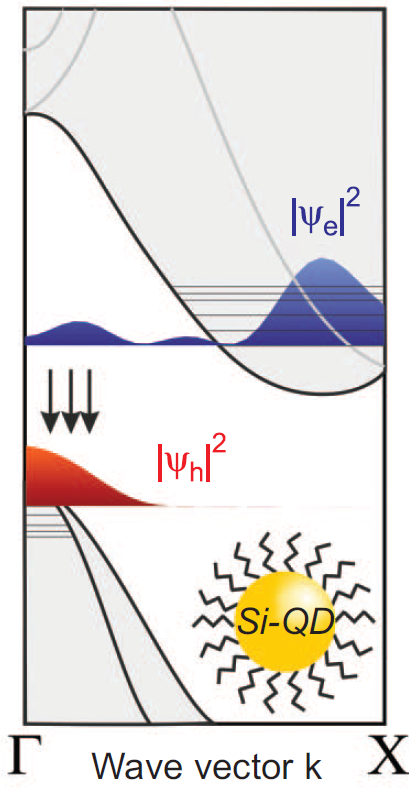
The research team, led by dr. Katerina Dohnalová in the group of prof. Tom Gregorkiewicz within the Institute of Physics, have now shown both eperimentally and theoretically that the surface chemistry of silicon QDs can be manipulated with a carbon coating in such a way that it results in a 'direct bandgap' transition. This result could be obtained with only little changes to the various energy levels, which implies that the spectrum conversion of the QDs stays largely the same. This enables for the first time a truly harmless, sustainable replacement of the toxic constituents of common QDs by silicon without affecting the optical properties and functionality. Their results were published in the latest issue of the Nature-journal Light: Science & Applications.
Future research will be targeted at optimizing the surface coating and at improvements in the size selection procedure.