Physicists reveal order in traffic jam chaos
Remarkable analogy published in Physical Review Letters
Physicists from the Institute of Physics at the University of Amsterdam made a link between the sudden appearance of traffic jams and the jamming of marbles in a jar.
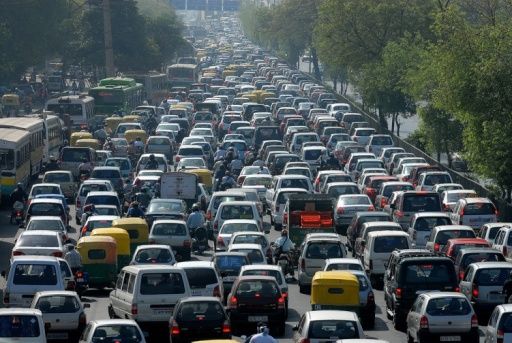
How do traffic jams emerge? And why do traffic jams appear so abruptly with sometimes no obvious reason or obstacle on the road? There are other examples that we encounter in daily life that show similar jamming as the traffic on the road: sand that gets jammed in an hourglass, peas, marbles or sugar that get stuck in a jar. The list is long, and includes even materials that suddenly get rigid when they settle, like cement, and materials that get solid from a liquid state when they cool down, like glass. The understanding of such phenomena requires a deep understanding of complex systems, where the interactions between many individual units become important. It is these interactions that conspire to arrest the entire system. While the phenomenon seems general and largely insensitive to the specific form of the interactions, it is not clear how the systems are related, and what makes them so vulnerable that they suddenly exhibit complete standstill.
Cars behave like molecules
Scientists in the team of dr. Peter Schall at the Institute of Physics of the University of Amsterdam have obtained new insight into this issue. Using computer simulations to model car traffic they investigated traffic flow with an increasing density of cars, and with increasing probability that drivers overreact by breaking. They compared the behavior of the cars in traffic with the behavior of molecules when a liquid cools down and becomes a solid glass. Their results, which are published in this week’s issue of the prestigious scientific journal Physical Review Letters, are surprising: in the limit where the motion comes to a stand-still, the cars behave just like molecules in an arresting liquid. Just before arrest, the increasingly slow motion organizes in a hierarchical way: the breaking of a car influences not only the car directly behind, but also the cars behind that car – in fact all cars behind the breaking one, albeit to an increasingly weaker extent. The effect of breaking (or accelerating) decreases with distance, but is always felt, even far away. Such correlated behavior is known in physics for providing sudden responses to small changes in parameters of the system. Well-known examples are phase transitions, such as transitions from gas to liquid or liquid to crystal. While these transitions describe equilibrium states that are time independent, the application of this idea to describe the sudden dynamic arrest of systems might provide a new framework to understand the standstill of many diverse systems around us – including the sudden collapse of traffic in busy rush hours or under poor weather conditions.
Applications of this research will include the investigation of complex materials such as food, or that of biological cells where the crowding of biopolymers such as DNA and proteins slows down the transport inside the cell.
Reference
A. S. de Wijn, D. M. Miedema, B. Nienhuis, and P. Schall: Criticality in Dynamic Arrest: Correspondence between Glasses and Traffic, Phys. Rev. Lett. 109, 22, 2012 (30 November 2012).