Electrons take a detour in superconductors
Researchers from the Institute of Physics (IoP) of the University of Amsterdam have, together with colleagues at the Leibniz Institute for Solid State and Materials Research IFW Dresden (Germany), identified the primary pathway that electrons take in tunneling experiments on high-temperature superconductors. In such an experiment electrons 'jump' from a thin needle to a superconducting surface to be investigated. Knowledge about the pathway that the electrons then follow gives insight into the question whether the relevant electronic structure leading to superconductivity is being probed. The researchers will published their results in the 19 September issue of Physical Review Letters.
Atomic resolution
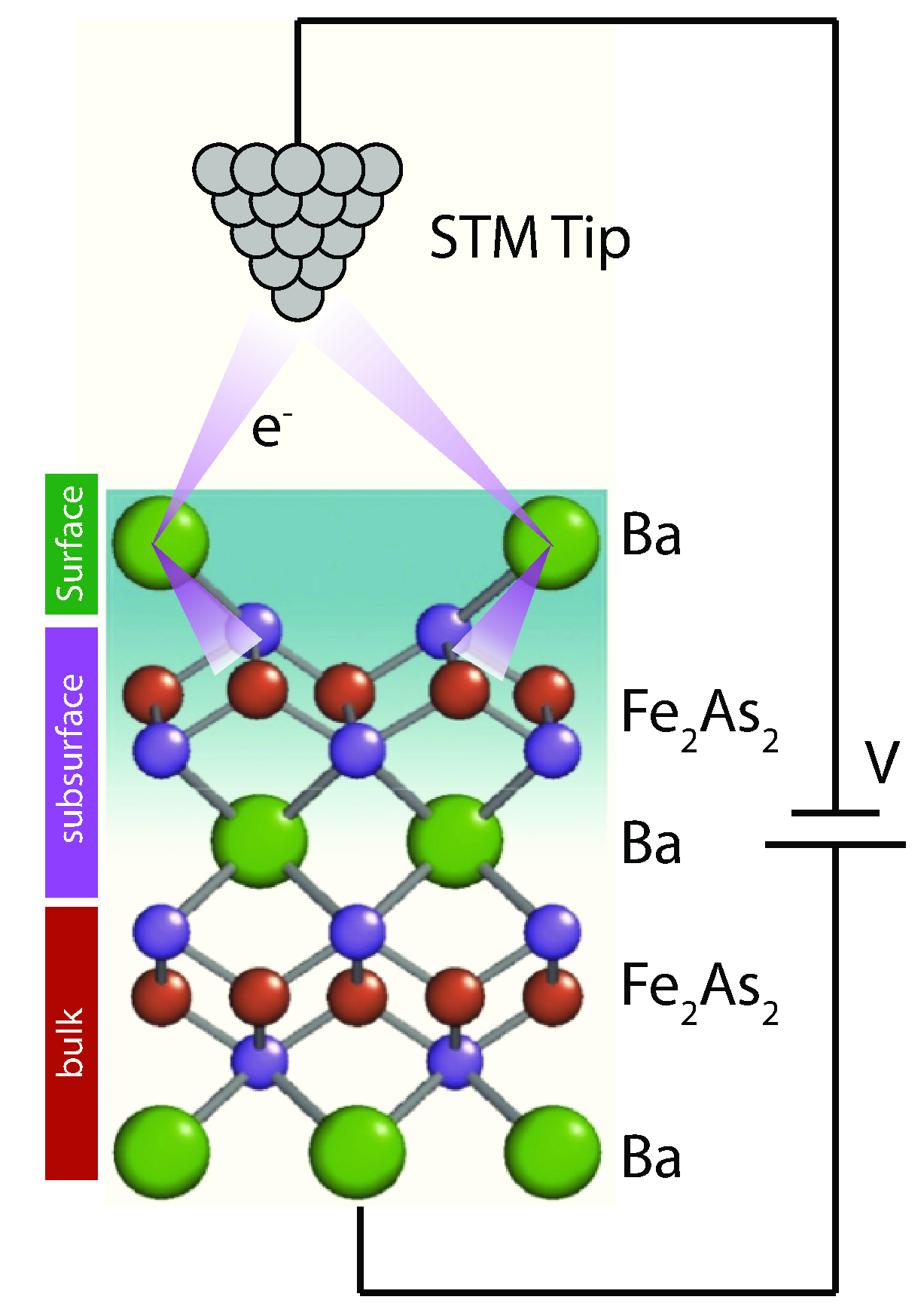
In scanning tunneling microscopy experiments researchers take a conducting needle, ending in a single atom, and bring it very close to a surface to be investigated. Even though there is no mechanical contact between the needle and the surface, a quantum mechanical effect (tunneling) allows for a current to flow if a voltage is applied between the needle and the surface. By measuring the current as function of voltage the researchers obtain information on the electronic structure of the surface directly under the needle with atomic resolution.
Theory and experiments
Researcher from Dresden modeled the tunneling process between an iron-arsenide superconductor and a Platinum STM-tip. They calculated the total tunneling current as well as the pathways followed by the electrons through the surface layers. It turns out that the pathway leading to the largest contribution in the tunneling current derives from the topmost layer of Barium atoms. The investigators from Amsterdam confirmed these findings experimentally through STM experiments on BaFe2As2 crystals. These results contribute to the search for the intrinsic properties of these materials relevant to the mechanism of high-temperature superconductivity, as these properties can now be distinguished from other effects.
Reference
K. Koepernik, S. Johnston, E. van Heumen, Y. Huang, J. Kaas, J. B. Goedkoop, M. S. Golden, and J. van den Brink, Phys. Rev. Lett. 109, 127001 (2012). https://prl.aps.org/abstract/PRL/v109/i12/e127001.