Why curvature matters
17 August 2026
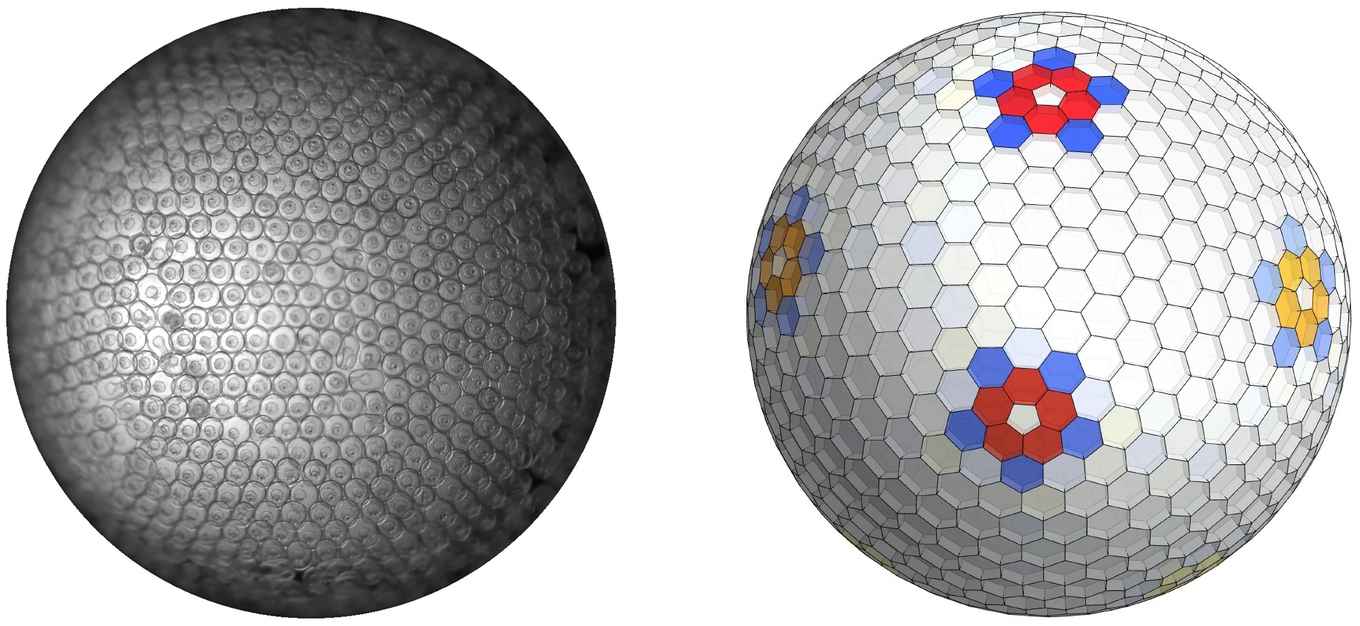
Living on a curved surface
Many materials, both living and engineered, are powered from within. Examples include tissues made of moving cells and mechanical metamaterials that use embedded motors or actuators. A major difference between such active materials and ordinary materials lies in the way they deform. Push an ordinary material, and it will deform where the force acts. Active materials, on the other hand, can generate further forces that redirect deformations, leading to all kinds of unexpected, but often quite useful, behaviour.
A striking example comes from observations in biological experiments, where starfish embryos were found to self-organize into crystal-like structures on a water surface. In this example, an extra factor comes into play: the water surface in the test tubes used in the experiments is not flat but slightly bent – just like the surface of water in an ordinary drinking glass that bends upward where the water touches the glass. One consequence of the curvature is that the starfish embryos don’t fit on the surface in a completely regular pattern: instead, the pattern has occasional irregularities or defects.
Capturing the role of curvature
Seeing these living crystals naturally form defects because of the surface curvature inspired a group of researchers to ask a simple but fundamental question: How does curvature determine the behaviour of active materials in general? To answer this question, the team, led from the University of Amsterdam in the Netherlands, brought together expertise in both theory and experiments, involving researchers from the Max Planck Institute for the Physics of Complex Systems (MPIPKS) in Dresden, Germany, Wrocław University of Science and Technology in Poland, and MIT in Boston, USA. Together, the team developed a framework to answer this question.
The framework that explains how internal activity and surface curvature work together to shape the mechanical behaviour of these active materials. Yuan Zhou, first author of the paper, explains: ‘We show that curvature does much more than bend the material. It determines where energy is injected, it creates new localized vibrations around unavoidable defects, and it makes boundaries much more prone to oscillate than the interior. Subsequent computer simulations confirmed the predictions of our theory.’
Geometry as a design parameter
The work does much more than just explain curious observations about starfish embryos. Corentin Coulais, the group’s principal investigator, looks ahead: ‘This work suggests that geometry can become a design parameter for active materials with a practical use. By carefully shaping a surface, it may be possible to control where mechanical activity, vibrations, and energy concentrate.’ The authors hope that their framework will inspire new experiments on both living tissues and active metamaterials, and may ultimately lead to materials whose function is programmed not only by their composition but also by their shape.
Publication
Curved odd elasticity, Yuan Zhou, Lazaros Tsaloukidis, Jack Binysh, Yuchao Chen, Nikta Fakhri, Corentin Coulais, and Piotr Surówka. Phys. Rev. Lett. (2026). Phys. Rev. Lett. 137 (2026) 088301.